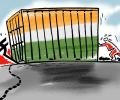
India has been relatively insulated from the severe headwinds in the West. However, with a third of the global economy expected to slip into recession in calendar year 2023, the impact will strongly be felt on India's exports and trade economy, leading economists said in a panel discussion at the Business Standard BFSI Insight Summit in Mumbai on Wednesday. The panel comprised former Reserve Bank of India executive director and former Monetary Policy Committee member Mridul Saggar, State Bank of India Chief Economic Advisor Soumya Kanti Ghosh, Citibank India Chief Economist Samiran Chakraborty, ICRA Chief Economist Aditi Nayar, and IndusInd Bank Chief Economist Gaurav Kapoor. The topic of the panel discussion was No recession in sight: Is India decoupled from developed economies?

'We have relatively strong growth and a healthy corporate earnings cycle as positives, but a worrisome current account deficit and high inflation as challenges.'

'The government should act proactively to instil confidence in the private investors, and also boost the purchasing power of people directly or indirectly by ensuring minimum wages.'

Banks have raised concerns over the new international trade settlement in rupee, fearing that facilitation of such a mechanism could result in them facing the ire of economic sanctions by the West, people aware of the matter said. Large banks with overseas operations have sought clarity and assurance from the Reserve Bank of India (RBI) that they will not be targeted with sanctions for facilitating rupee trade with a sanction-hit country such as Russia. The present payment mechanism is a shift from earlier such arrangements, like the one with sanction-hit Iran, which involved banks facilitating settlement of international trade that did not have business in the sanctioned nation.

The 2014 Australian Grand Prix posted a record A$59.97 million ($55 million) loss amid soaring costs and declining revenue, government officials said on Wednesday.

The Central Electricity Authority (CEA) has projected an energy shortfall of 10.3 per cent and a peak shortage of 12.9 per cent in the country during the current financial year (2011-12).

'The finance ministry and the RBI will never admit to the difficulties in the economy because if they do so, it will adversely impact the financial markets, etc.' 'They like to present a rosy picture that everything is fine and under control.'

India must integrate more with East Asia by getting into regional trade arrangements, lower its tariff walls, and improve the quality of its workforce, suggests T N Ninan.

The central bank can directly print money and finance the government, but it should avoid doing so unless there is absolutely no alternative, former RBI governor D Subbarao on Wednesday said while pointing out that India is 'nowhere' near such a scenario. In an interview with PTI, Subbarao suggested that to deal with the second wave of COVID-19 induced slowdown in the economy, the government can consider Covid bonds as an option to raise borrowing, not in addition to budgeted borrowing, but as a part of that.

India's current account surplus moderated to $15.5 billion or 2.4 per cent of the GDP in the July-September quarter of the current fiscal, the RBI said on Wednesday. The same was at $19.2 billion or 3.8 per cent of the GDP in the preceding three-month period on account of a rise in the merchandise trade deficit, the RBI said in a statement on 'Developments in India's Balance of Payments during the Second Quarter (July-September) of 2020-21'. It is for the third consecutive quarter that India's current account remained in surplus. In the last quarter of 2019-20, the surplus was $0.6 billion. Current account deficit/surplus reflects the difference between the outflow and inflow of foreign exchange in a country's current account.

'The actions of Indian monetary authorities will depend on how quickly they want the inflation to come down to 4 per cent.'
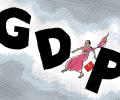
Moody's said the government will face challenges in achieving its deficit target for the fiscal year ending March 2021, amid persistent structural and cyclical headwinds to growth.
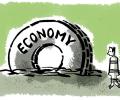
Moody's Investors Service on Friday projected India's growth at zero per cent for the current fiscal and said the negative outlook on sovereign rating reflects increasing risks that GDP growth will remain significantly lower than in the past. The outlook also partly shows weaker policy effectiveness to address economic and institutional issues, it noted in the update to its November 2019 rating forecast.

Nepal's decision to ban the import of non-essential items amid depleting forex reserves may hit Indian exports. The country's central bank - Nepal Rastra Bank - last week instructed commercial banks not to open letters of credit (LCs) for importing non-essential items. This is to prevent further decline of the country's foreign exchange reserves. However, it has not issued any formal communication yet.

The government may have to resort, eventually and however unwillingly, to printing money, abandoned as policy and practice in the 1990, predicts T N Ninan.

The shortfall in GST compensation payable to states in the current fiscal is estimated at Rs 2.69 lakh crore, of which Rs 1.58 lakh crore would have to be borrowed this year. The Centre expects to collect over Rs 1.11 lakh crore through cess on luxury, demerit and sin goods which will be given to the states to compensate them for the shortfall in revenue arising out of GST implementation. The remaining Rs 1.58 lakh crore would have to be borrowed to meet the promised compensation to states under the Goods and Services Tax (GST) regime.

Finance Minister Nirmala Sitharaman is scheduled to address the post-budget meeting of the RBI's central board on Monday and highlight key points of the Union Budget 2022-23, including the fiscal consolidation roadmap and high capex plan. It has been a custom that the finance minister addresses the RBI board, consisting of RBI Governor and existing four deputy governors, after the Budget. The meeting has been scheduled for February 14 where she would be addressing the board members and talk about announcements made in the Budget to perk up growth hit by three waves of COVID-19, sources said.

The Reserve Bank on Wednesday hiked key benchmark policy rate by 25 basis points to 6.5 per cent, citing sticky core inflation. This is the sixth time interest rate has been hiked by the Reserve Bank of India (RBI) since May last year, taking the total quantum of hike to 250 basis points. Announcing the bi-monthly monetary policy, RBI Governor Shaktikanta Das said the Monetary Policy Committee (MPC) by a majority decided to raise the policy repo rate by 25 basis points and keep a 'strong vigil' on inflation outlook.

Finance Minister Nirmala Sitharaman on Wednesday raised the personal income tax rebate limit, doled out sops on small savings and announced one of the biggest hikes in capital spending in the past decade as she did a tight rope walk in the Budget between staying fiscally prudent and meeting public expectations in the year before general elections.

The bulk of states' revenue comes from the devolution from the Centre's divisible tax pool, GST, VAT on petroleum, and excise duty on alcohol.

The fresh restrictions imposed in Maharashtra to contain the second wave of COVID-19 are likely to impact the festive season auto sales, as Navaratri and Gudi Padwa are falling in April, according to rating agency Icra. These two festivals account for a sizeable chunk of the annual vehicle sales across the country, especially in Maharashtra, it said. Gudi Padwa, which is a major festival of Maharashtra, will be celebrated on April 13, while Navrarati will also begin on the same day.
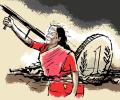
'But can it afford to present a scenario within the existing legal framework of fiscal consolidation?', asks A K Bhattacharya.

India's macroeconomic situation is improving fast and the country's GDP growth will turn positive in the third and fourth quarters of the current financial year, eminent economist Ashima Goyal said on Sunday. Goyal in an interview to PTI said the management of the COVID-19 pandemic and gradual unlocks announced by the government have helped in avoiding multiple COVID-19 peaks. The growth estimates by different agencies are being continuously revised, she said.

Given the prevailing uncertainties, investors must maintain a 10-15 per cent allocation to gold in 2023.

'You may see some movement indicating a simpler tax regime with less exemptions but with fewer tax rates making life simpler for taxpayers.'

The Budget oration of the finance minister and the confidence with which she delivered it, along with the measures and the recent upsurge in the economy would all contribute to unleashing the storied 'animal spirits' and help the economy run on the growth path quite smoothly. Or so the government hopes, notes Shreekant Sambrani.

The power failure comes at a time when the state is reeling under power deficit.

The decline in gold imports has helped in narrowing the country's trade deficit to $106.84 billion during the eight-month period under review as against $133.74 billion in the year-ago months.

The Budget, to be presented on February 1, is likely to be less worried about fiscal deficit and will be focused more on nursing the fragile growth, according to a Wall Street brokerage report. Bank of America Securities India expects the budget to peg "fiscal deficit at a high 5 per cent of GDP for FY22 and 7.2 per cent for FY21, as it is likely to step up capex, recap public sector banks, push asset sales to break government monopolies, offer sops for real estate, tax cuts for lower income groups and creation of a bad bank". Its house economists expect these spends to be funded by debt and partly by imposing a cess on high income groups and also by some non-fiscal measures like tapping the central bank's revaluation reserves and bank recapitalisation and infra bonds.

'There are unscrupulous traders who create fake invoices by showing bogus e-way bills, movement of goods.' 'Since the entities registered across different states, and kept on changing their numbers, tracing them was difficult.'

While most experts suggest the government loosen its purse strings and not worry about the fiscal deficit in a pandemic impacted year, it will be a tightrope walk for the government to increase spending without going overboard.

'For the next two years, we expect the bulk of earnings growth contribution from sectors like financials and energy, where the outlook remains positive, while the sectors which are linked to domestic consumption and are currently witnessing strains on margins have low salience for Nifty earnings.'

From social engineering to bearing the cost of COVID-19 treatment to financial reconstruction of Tamil Nadu's debt the debutant chief minister is emerging as a leader with a difference, says Shjne Jacob
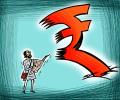
The rupee appreciated 7 paise to 79.74 against the US dollar in early trade on Thursday as a positive trend in domestic equities supported the local unit. However, a strong American currency overseas and forex outflows restricted the rupee's gain, dealers said. At the interbank foreign exchange, the rupee opened at 79.72 against the American dollar, then went lower to trade at 79.74 against the greenback in early deals, registering a gain of 7 paise over the last close.

The sweeping economic sanctions on Russia - the second largest producer of crude oil - following its invasion of Ukraine late last month can cull global and domestic growth along with the added pains of higher inflation and currency depreciation, RBI Deputy Governor Michael Patra has said. And if the war lingers on, it can even lead to deglobalisation and even a recession, he added. The ongoing war has only added a whole new dimension to the outlook, and in fact, a weighty downside, Patra said in a lecture at the industry lobby IMC on Friday evening.

Observing that India's worsening COVID-19 situation and the strict measures to contain it have hit the economy hard, the rating agency said productive capacity has been severely disrupted since the start of the pandemic.
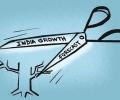
India's projected economic growth for 2022 has been downgraded by over two per cent to 4.6% by the United Nations, a decrease attributed to the ongoing war in Ukraine, with New Delhi expected to face restraints on energy access and prices, reflexes from trade sanctions, food inflation, tightening policies and financial instability, according to a UN report released on Thursday. The UN Conference on Trade and Development (UNCTAD) report downgraded its global economic growth projection for 2022 to 2.6 per cent from 3.6 per cent due to shocks from the Ukraine war and changes in macroeconomic policies that put developing countries particularly at risk. The report said while Russia will experience a deep recession this year, significant slowdowns in growth are expected in parts of Western Europe and Central, South and South-East Asia.

Revising up inflation bands for the central bank will hurt the poor, former deputy governor of RBI Viral Acharya said on Wednesday, terming the current 4 per cent midpoint on price-rise as a "reasonable target".

These jobs don't necessarily require a degree in engineering or specialisation in coding.

No longer Bengal's finance minister, Amit Mitra, Mamata's principal chief advisor, will still advise and aid the 'chief minister and finance department on all matters relating to management of state finance', represent the 'state government in national and international events/meetings/committees' and examine 'important proposals/files and policy issues relating to financial matters referred to him for advice/views'.
